
Air Lifting Bags and Load Test Bags: How to Choose the Right Fabric
Coating, Flexible Storage Tanks, International Standards, Production, UAV, Welding, coated textile sourcingSep 23, 2026
Share this Post

Fabric selection usually starts with what the product holds. Water, fuel, air. That’s the right first question, but it isn’t the one that decides where the material fails. Lifting and load bags make the point clearly, because the same family of products loads its fabric in five different ways.
Air lifting bags, load test bags, and inflatable rescue cushions look like different products, and in the field, they are. A crane test bag hangs from a hook full of water. A salvage bag rises from the seabed on compressed air. An aircraft lifting bag raises a disabled airliner off the runway. A door-breaching cushion slides into a gap a few millimeters wide and forces it open.
What they share is the material. Almost all of them are built from coated technical textile, typically polyurethane-coated polyester or nylon, joined by high-frequency welding. What changes across the family is how heavy that fabric is, how it is loaded, and which property decides whether the product survives. At one end sit heavy, robust fabrics built to carry tonnes in tension. At the other sit very light fabrics built to fit into a narrow gap and still hold pressure. This article works through the family from heavy to light, and what each product asks of the coated textile.
Low Pressure vs High Pressure Lifting Bags
Before looking at individual products, one distinction matters more than any other, because it decides whether a lifting bag is a coated fabric product at all.
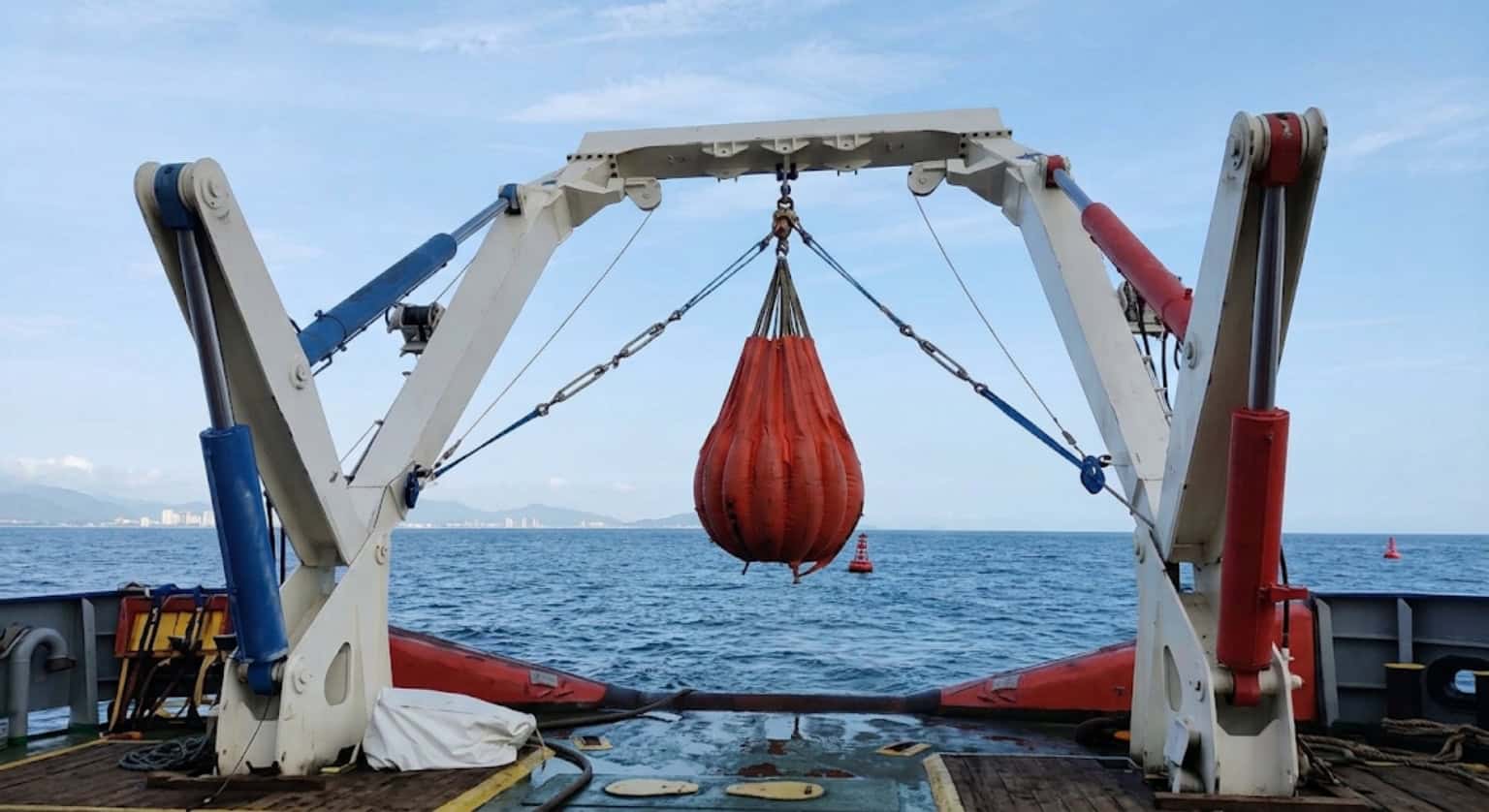
High-pressure lifting bags operate at several bar and lift a short distance. They are flat, compact and very powerful for their size, and they are generally built from rubber with internal reinforcing plies rather than from coated fabric.
Low-pressure lifting bags operate at a fraction of that pressure, lift much higher, and spread the load over a much larger contact area. These are coated fabric products. Aircraft lifting bags, most salvage bags, and the large rescue bags used to right overturned vehicles all sit in this group.
When a specification calls for coated textile, it is almost always a low-pressure application. The rest of this article is about that side of the market.
Crane Load Test Water Bags: The Fabric Carries the Test in Tension
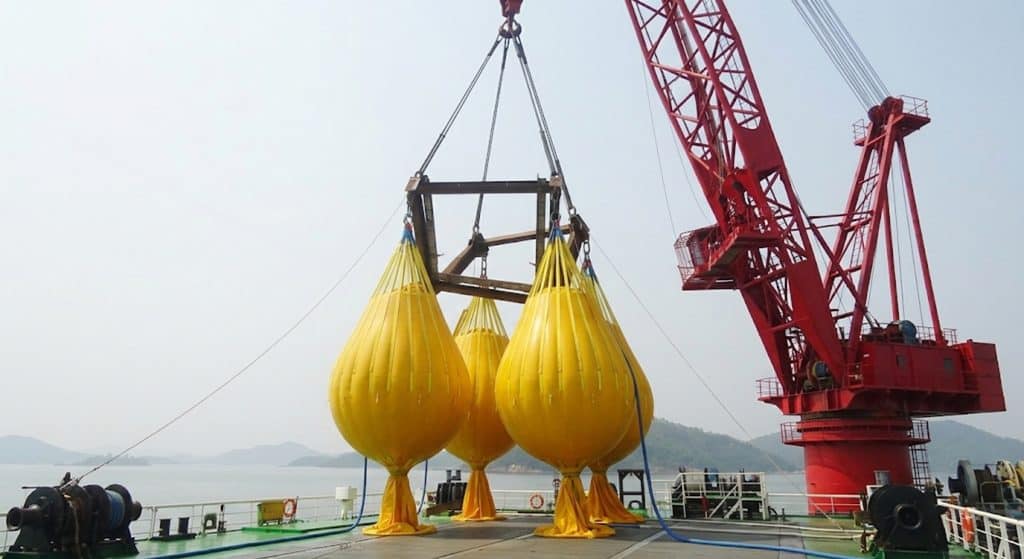
Load test bags are used to proof test cranes, davits, lifeboat launching systems and other lifting equipment. The bag is suspended from the hook and filled with water until it reaches the required test weight, which for a proof load test sits above the rated working load of the equipment. Water is used because the load can be applied gradually, measured accurately, and released safely.
This is the heaviest end of the family, and the load case is unlike anything else in it. The fabric is not containing pressure or providing buoyancy. It is carrying the entire test load in tension, transferred through a webbing harness into the bag body, while suspended in air.
What that demands from the fabric:
- High tensile and tear strength, because the test load is by definition greater than the equipment will normally see
- Seam strength at least equal to the base material, since a seam failure drops the full load
- Abrasion resistance, because test bags are dragged across decks, quaysides and concrete between tests
- Resistance to repeated fill and drain cycles, often combined with folding for transport between sites
- UV stability, since test work is done outdoors and bags are stored in yards
A test bag that fails under load is a safety incident, not a product defect. That is why this end of the range runs on the heaviest and most robust constructions.
Underwater Salvage Lift Bags: Air, Immersion and Pressure Cycling
Salvage lift bags recover objects from the seabed, support underwater construction, and provide buoyancy for pipeline and cable work. They are also standard equipment on diver-led recovery work, from commercial salvage to underwater archaeology, where the bag has to be positioned, filled and controlled by hand at the load. They turn compressed air into lift: each liter of displaced water produces roughly 1 kilogram of buoyant force, slightly more in seawater.


The complication is that air expands as the bag rises. As ambient pressure drops, the expanding air increases buoyancy, which accelerates the ascent, which drops the pressure further. Commercial bags carry automatic pressure relief valves and vent points for this reason, so the load case on the fabric is a pressure cycle on every lift rather than a steady state.
Three conditions shape the fabric specification:
- Concentrated point load. The full weight of the object transfers through shackles and webbing into the envelope at a small number of attachment points. Tear propagation resistance and coating adhesion around those points govern whether minor damage becomes a lost load.
- Air retention as a safety requirement. Slow air loss on a suspended load means the load sinks. Very low porosity across the whole envelope is essential, the same property that makes TPU-coated textiles standard for life raft buoyancy tubes.
- Continuous immersion and contamination. The fabric works in the water, not on it, so hydrolytic stability sits at the centre of the specification. Salvage sites also leak fuel and hydraulic fluid, which makes hydrocarbon resistance standard rather than optional.
How that load reaches the fabric is a design decision in itself. On light duty bags, webbing straps are stitched to doubler patches which are then glued or welded to the envelope. On large and heavy duty bags, strips of bag material are bonded to the body to form flat retaining tubes, and the webbing is threaded through them rather than fixed to them. That allows the webbing to be withdrawn for inspection and replacement without touching the envelope, and it keeps the stitching out of the air barrier entirely. On open parachute-type bags the straps run from the lifting point at the bottom, through the guide tubes along the sides, up to a crown ring at the top, so the load is spread along the full height of the fabric instead of being concentrated at a few patches. Either way, the bonded or welded interface between those reinforcements and the envelope is doing structural work, which is why coating adhesion matters as much as base cloth strength in this application.
For offshore and commercial diving work, open parachute-type bags are examined, tested and certified in line with IMCA D 016, which governs the finished device and its use rather than the fabric.
Rescue Lifting Bags for Vehicle Accidents and Rollovers
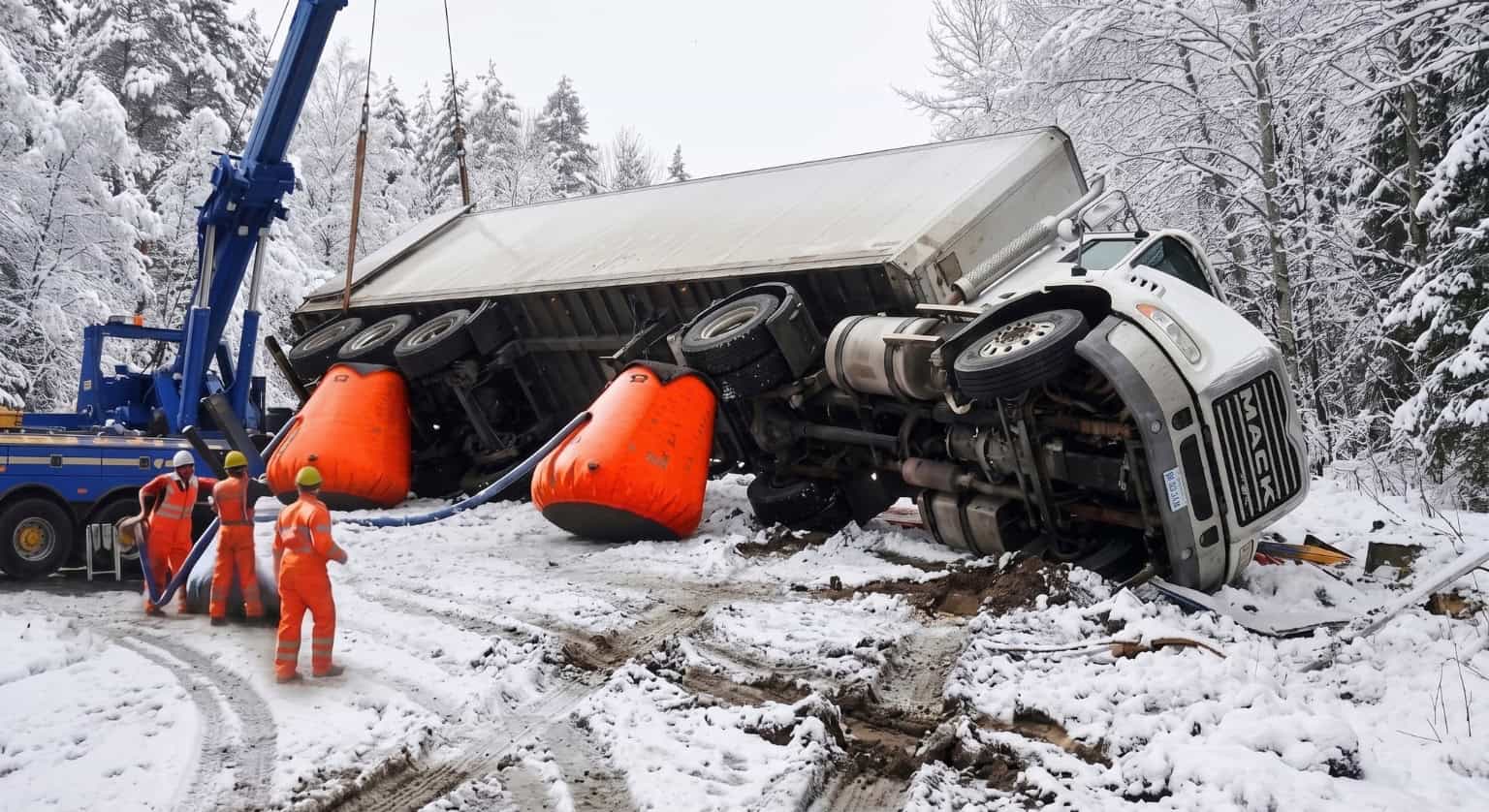
Rescue services use low-pressure lifting bags to stabilise and lift overturned trucks, buses and heavy vehicles, often to free a trapped person. Compared with high-pressure bags, they offer far more lift height and a wide footprint that spreads the load under an irregular, damaged structure.
Aircraft Lifting Bags: Multi-Cell, Low Pressure, Large Footprint
When an aircraft suffers a gear collapse or leaves the runway, it has to be lifted without adding damage to the airframe. Aircraft lifting bags do this by inflating beneath the wing or fuselage at low pressure over a large contact area, so the load is spread across the skin and structure rather than concentrated at a point.
[IMAGE NEEDED: civilian aircraft on multi-cell lifting bags] Alt text: Multi-cell aircraft lifting bags inflated beneath the wing of a disabled aircraft
Most are multi-cell designs. Each cell is inflated independently, which lets the recovery team control the rate and evenness of the lift and adjust for the attitude of the aircraft as it rises.
What this asks of the fabric:
- Large welded panels with consistent properties. These are among the largest items in the family, so material consistency across wide panels and long weld lines matters.
- Controlled, even behaviour under load. A cell that stretches more than its neighbour tilts the lift. Dimensional stability under pressure is a real requirement, not a detail.
- Jet fuel and hydraulic fluid resistance. Recovery sites are contaminated with both.
- A surface that does not damage the aircraft. The contact face works against painted and composite surfaces.
Door-Breaching and Entry Cushions: The Ultralight End
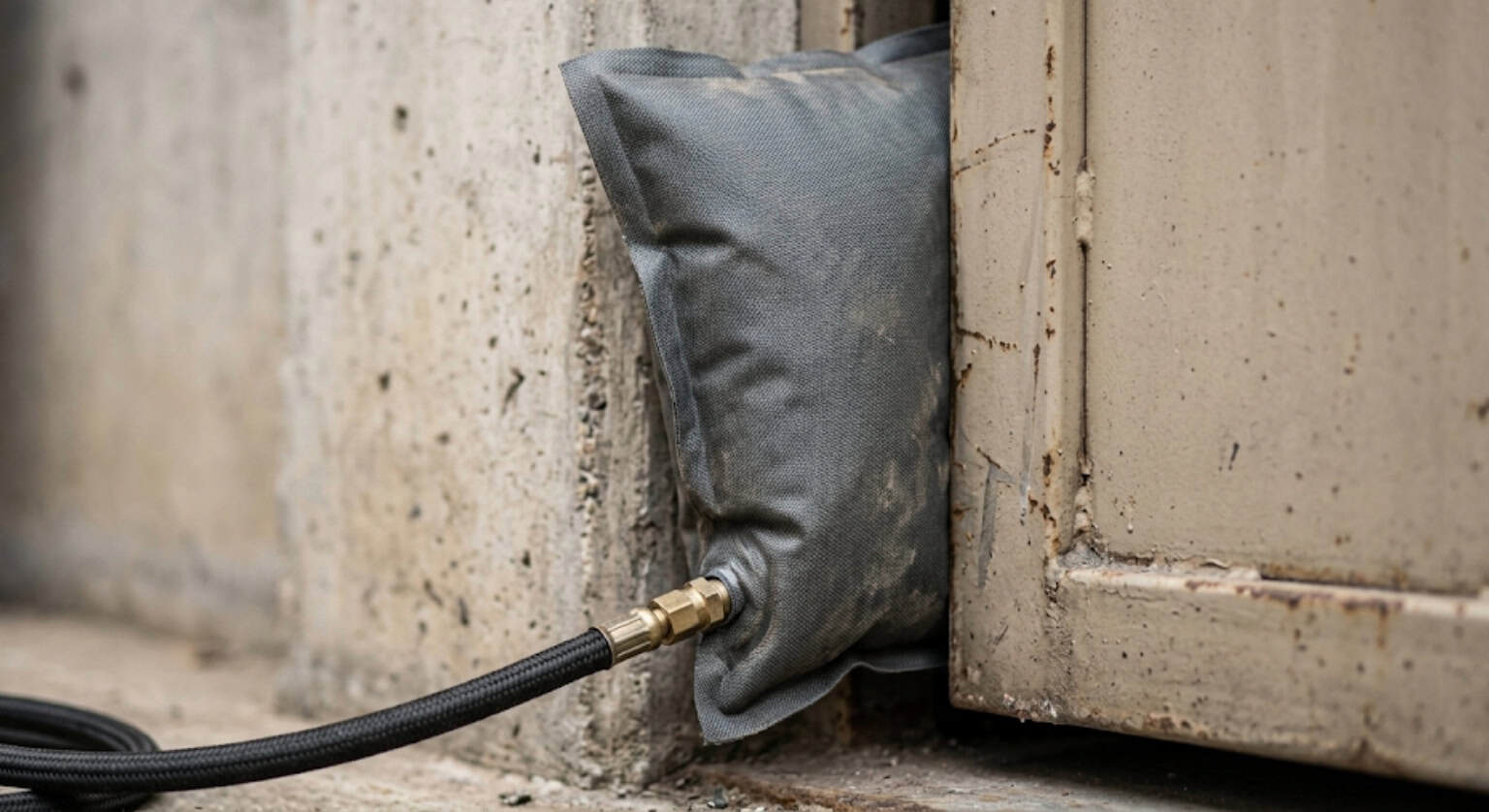
At the opposite end of the family are flat inflatable cushions used by rescue services for emergency entry. The deflated cushion is slid into a narrow gap, typically between a door and its frame, then inflated to force the gap open without cutting or striking. Everything about this product pushes towards light fabric. The cushion has to be thin enough to enter a gap of a few millimetres, yet hold enough pressure over a small area to open a locked or jammed door. The controlling properties are:
- Burst strength relative to weight, because the cushion is very light and very small but carries a concentrated force
- Edge tear resistance, since the edges are pressed against metal frames and sharp profiles
- Flexibility and a thin profile, so the cushion can be inserted and folded repeatedly without coating damage
- Rapid inflation behaviour, so the force builds predictably
This is where coating thickness and base cloth selection are most tightly balanced. Too much material and the cushion will not enter the gap. Too little and it will not hold the pressure.
One Family, Different Controlling Properties
| Product | Medium | How the fabric is loaded | Controlling property | Fabric class |
|---|---|---|---|---|
| Crane load test bag | Water | Full test load in tension, suspended | Tensile and seam strength | Heavy |
| Underwater salvage bag | Air | Pressure cycling, point load at attachments, immersed | Air retention, tear propagation, hydrolysis | Heavy to medium |
| Rescue lifting bag | Air | Low pressure under damaged structure | Puncture and cut resistance | Medium |
| Aircraft lifting bag | Air | Low pressure over a large area, multi-cell | Dimensional stability, fuel resistance | Medium |
| Door-breaching cushion | Air | Concentrated force over a small area | Burst strength to weight, edge tear | Light |
The pattern is the same one that runs through flexible storage tanks: the liquid or gas matters, but the way the product is loaded decides where the fabric fails.
Why Welding Matters Across the Whole Range
Every product in this family is under load at its seams. Test bags carry tonnes through them. Salvage and rescue bags cycle pressure through them. Door-breaching cushions concentrate force right up to their edges.
A welded TPU seam fuses the coating layers into continuous material, so the seam does not behave as a separate element with its own failure point. Adhesive seams rely on a bond with finite shear capacity that degrades under repeated loading. The same reasoning explains why welded TPU displaced glued rubber systems in flexible fuel bladders. Weldability also governs repair: a welded patch restores the original construction method rather than introducing a new one.
Standards and Certification
Certification in this family happens at product level. Load test bags are certified to their rated capacities by the manufacturer. Open parachute-type salvage bags used in offshore diving follow IMCA D 016, which covers examination, testing, certification and maintenance. Lifting bag systems for fire and rescue service use in Europe are covered by EN 13731:2007, which applies to the complete system, including hoses, regulators, control devices and safety valves as well as the bags themselves.
In each case the fabric supports compliance rather than satisfying it directly. When specifying fabric for a product that will be certified, the useful question to a fabric supplier is not whether the fabric carries the certification, but whether the supplier can provide the test data the certification process will require.
Specifying Erez Fabric for Your Lifting Bag
Erez supplies coated fabrics across this family, from heavy, robust constructions for load test and salvage bags to light fabrics for inflatable entry cushions. REZcoat™ TPU coated fabrics are produced on polyester and nylon base cloths, and grade selection follows from load, pressure, medium and duty cycle rather than from the product category alone.
Frequently Asked Questions
What are air lifting bags made of?
Low-pressure air lifting bags are built from coated technical textile, typically polyurethane-coated polyester or nylon, joined by high frequency welding. High-pressure lifting bags are a different product, generally made from rubber with internal reinforcement.
What is the difference between low-pressure and high-pressure lifting bags?
High-pressure bags operate at several bar and lift a short distance with great force from a compact size. Low-pressure bags operate at much lower pressure, lift much higher, and spread the load over a large area, which makes them suitable for aircraft recovery, vehicle righting and underwater salvage.
How do aircraft lifting bags avoid damaging the aircraft?
They inflate at low pressure over a large contact area, so the load is spread across the structure. Multi-cell designs let each cell be inflated independently to control the rate and evenness of the lift.
Why are crane test weights made from water bags?
Water lets the test load be applied gradually, measured accurately and released safely. The bag is filled to the required test weight, which for a proof load test sits above the rated working load of the equipment.
Can the same fabric be used for a load test bag and a door-breaching cushion?
No. They sit at opposite ends of the range. A load test bag needs heavy fabric to carry tonnes in tension. A door-breaching cushion needs very light fabric thin enough to enter a narrow gap while still holding pressure.
Matching load, pressure and deployment to one material is the core of every lifting bag specification. Schedule a technical review with the Erez textile team to work through the requirements for your design.
Related reading: Marine textile fabric safety applications | The most common uses of waterproof TPU coated fabric
Share With Colleagues
Share this Post
Read More

Leave A Comment
How do you ensure the best technical textile for your product?