
Diesen Beitrag teilen

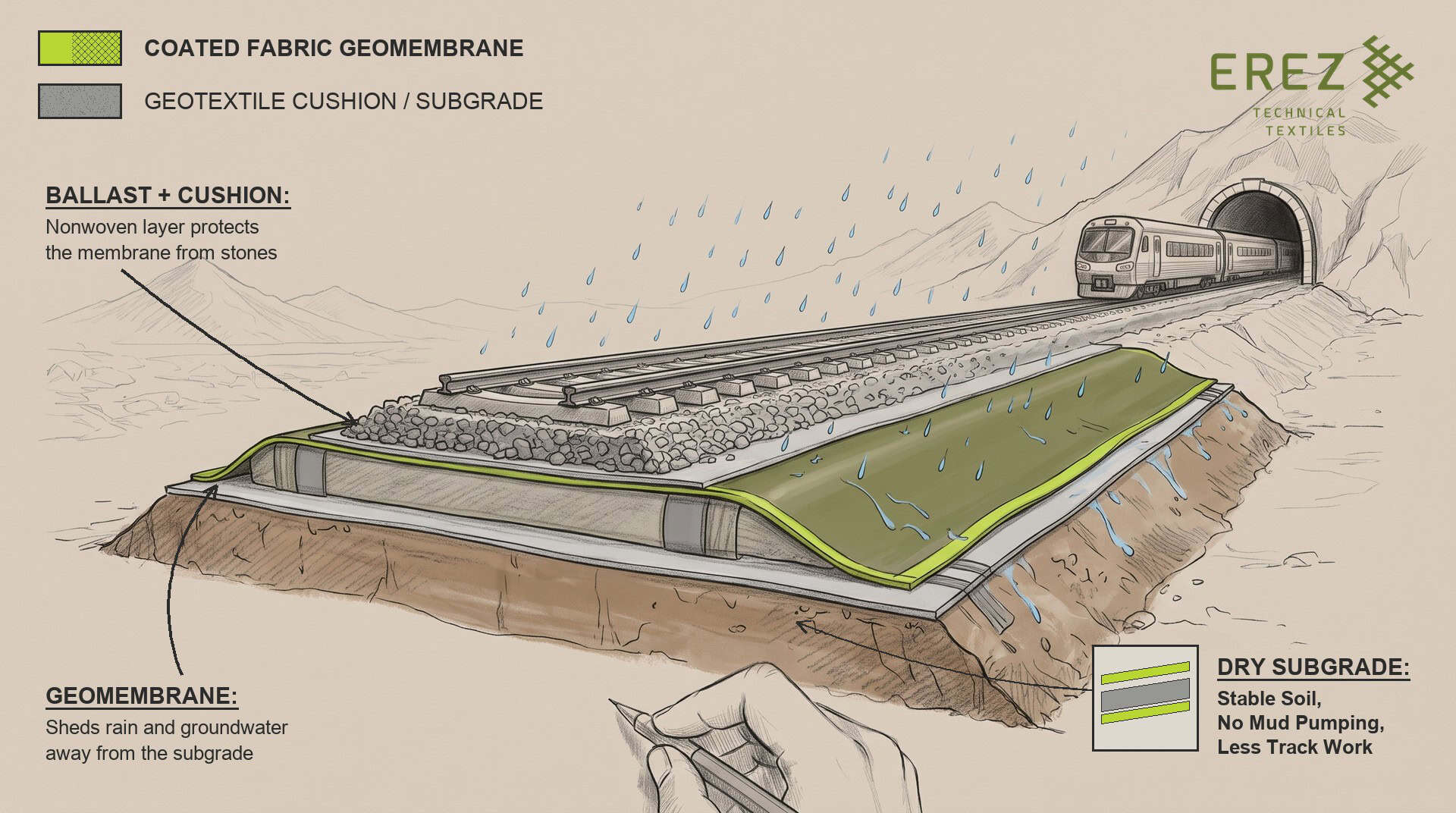
A track that keeps losing its geometry rarely has a rail problem. It has a water problem. Rain and groundwater soften the subgrade, fines climb into the ballast, and the maintenance crew is back on the same section every season. The same is true for light rail, trams and trolley lines.
A geomembrane stops that cycle at the source: an impermeable layer that keeps water away from the soil the track depends on. In railyards it does a second job, keeping fuel and chemicals out of the ground. In tunnels it holds back groundwater for the life of the structure.
This guide was developed with our Partner Group company E² Geomembranes, who design and supply liner systems for containment and civil projects. Below: the four places a membrane earns its cost on a rail project, and how to choose the right material for each.
1. Subgrade and Embankments: Keep the Soil at Design Moisture
The subgrade was designed for a certain moisture content. Once water gets in, bearing capacity drops and the track starts to settle. A membrane under the ballast section (or wrapped around a problem embankment) keeps the soil where the engineer expected it to be.
- Problem soils: swelling clays, gypsum-rich soils, caliche and collapsible loess all react badly to water. Sealing them off is often cheaper than replacing them.
- Mud pumping: under traffic, wet fines are pumped up into the ballast and foul it. A membrane cuts the water supply that drives it.
- Lifecycle cost: one installation versus repeated tamping, ballast cleaning and speed restrictions.
2. Railyards: Spill Containment Where Fuel Is Handled Every Day
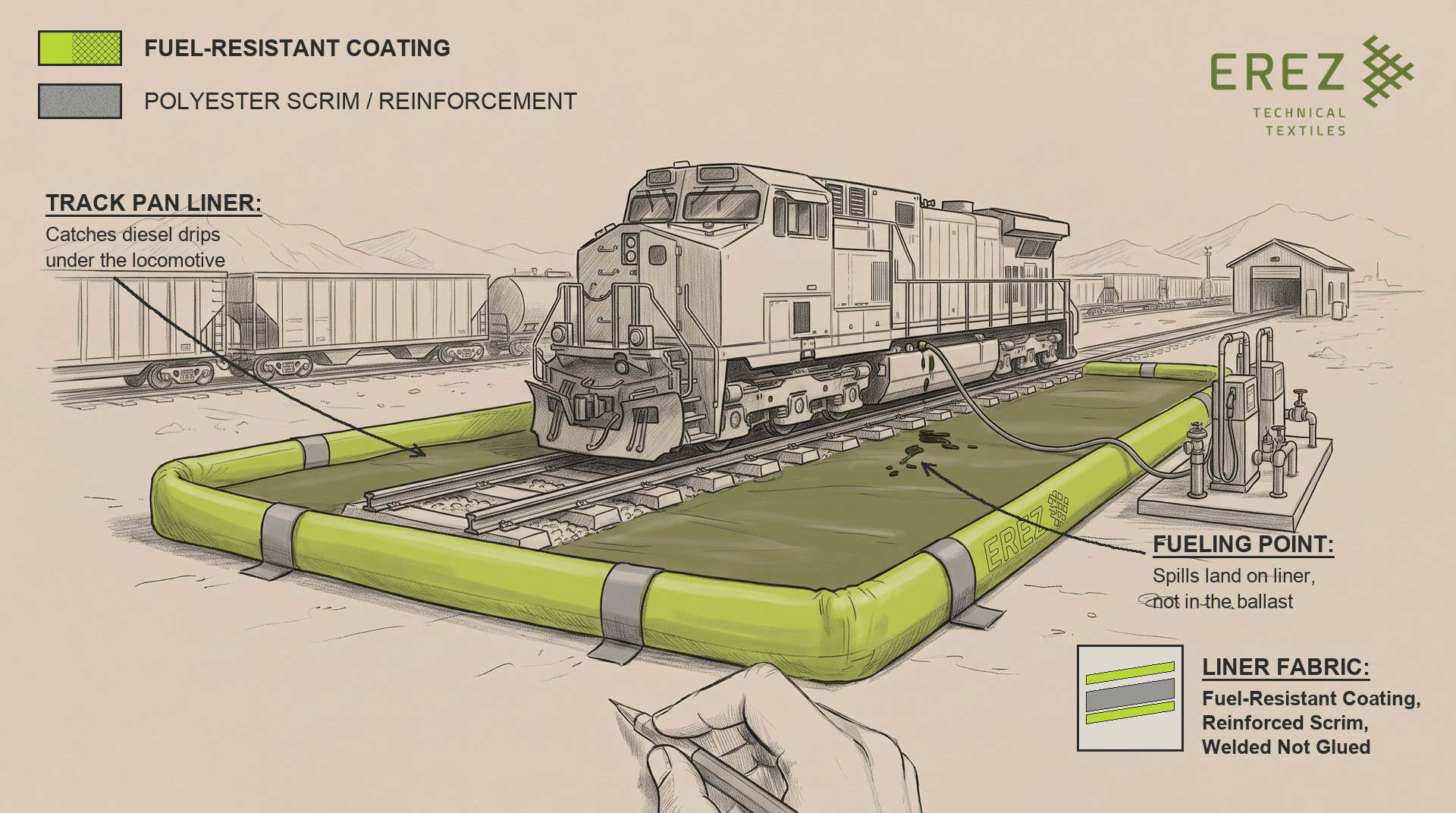
Fueling pads, locomotive servicing, wash racks and transload areas see drips and spills daily. Lined containment areas catch them before they reach soil and groundwater, and help the yard meet its secondary containment requirements.
Here the material choice matters most. HDPE and LLDPE are the usual starting point, but long contact with diesel, lubricants and hydraulic fluids can swell or weaken them. For areas with constant hydrocarbon exposure, engineers often move to a reinforced coated fabric: a polyester scrim coated with a fuel-resistant polymer such as EIA, TPU or a fuel-grade PVC. You get chemical resistance plus tear strength that holds up to equipment and foot traffic.
The rule: specify against the real chemicals on site, at the real temperatures, not against a generic chart. Our guide to EIA coated fabrics compares EIA, PVC and TPU side by side.
3. Tunnels: Waterproofing for the Life of the Structure
In a tunnel, groundwater is not an event, it is a permanent load. Membranes are installed as a seepage barrier between the ground and the lining, often as a double layer with a drainage layer between them so leaks can be detected and managed.
The membrane itself rarely fails. The details do: joints, penetrations and field seams. Seams are made by hot wedge welding or extrusion welding, and every seam should be tested on site with air-pressure or vacuum-box testing.
4. Special Cases: Electrical Isolation and Direct Ballast Contact
- Stray current and dielectric protection: under platforms and near electrified track, use products built and rated for electrical insulation. A general-purpose geomembrane is not an insulator spec.
- Ballast on top of the membrane: textured, heavy-gauge membranes add friction and stability, but sharp ballast still needs a protective cushion layer. Texture is not a substitute for protection.
Where a Geomembrane Pays Off: Summary
| Area | What the membrane does | What you gain |
|---|---|---|
| Subgrade and embankments | Keeps water out of moisture-sensitive soil | Stable track geometry, less maintenance |
| Railyards | Contains fuel, oil and chemical spills | Protected soil and groundwater, easier compliance |
| Tunnels | Blocks groundwater seepage | Dry structure, longer lining life |
A Membrane Works as Part of a System
A liner is only as good as the layers around it. A typical rail build-up includes:
- Nonwoven geotextile cushions above and below the membrane, even with textured sheets. Check puncture resistance (ASTM D4833) and thickness (ASTM D5199).
- Drainage geocomposites where water must be moved away, not just stopped.
- Seam quality control, with documented field testing.
- Installation planning: staging around track possessions and limiting UV exposure before cover.
Coated Fabric or HDPE? A Quick Rule of Thumb
For large open areas with water only, a standard geomembrane is usually the economic choice. When the liner faces fuels and oils, traffic, repeated folding, or needs to be prefabricated into panels and welded in a factory before it reaches site, a reinforced coated fabric is often the safer spec. Erez manufactures these fabrics in PVC, TPU and EIA, and works with fabricators and liner installers on the right grade for each application.
FAQ
What is a geomembrane used for in railway construction?
It is used as a waterproof barrier to protect the subgrade from water, to contain fuel and chemical spills in railyards, and to waterproof tunnels against groundwater.
Does a geomembrane stop mud pumping?
It removes the main cause. Mud pumping needs water in the subgrade; a membrane keeps the subgrade dry, so fines are not pumped into the ballast.
Which liner material is best for a railyard fueling area?
It depends on the chemicals and exposure time. For constant contact with diesel and oils, a reinforced fuel-resistant coated fabric (EIA, TPU or fuel-grade PVC) is often more durable than standard HDPE or LLDPE.
Can ballast be placed directly on a geomembrane?
Not without protection. Use a nonwoven geotextile cushion between the ballast and the membrane, even when the membrane is textured.
Planning a rail or railyard containment project? Ask an Erez expert which coated fabric fits your chemicals and site, or contact our partner E² Geomembranes for full liner system design.
Related reading: Secondary Containment Requirements: Rules, Berms and Liner Materials · Spill Containment Solutions: Development Considerations
Mit Kollegen teilen
Diesen Beitrag teilen
Mehr lesen

Einen Kommentar hinterlassen
Wie stellen Sie sicher, dass Ihr Produkt das beste technische Textil erhält?