
Secondary Containment Requirements: Rules, Berms and Liner Materials
Environmental Control, International StandardsJul 18, 2022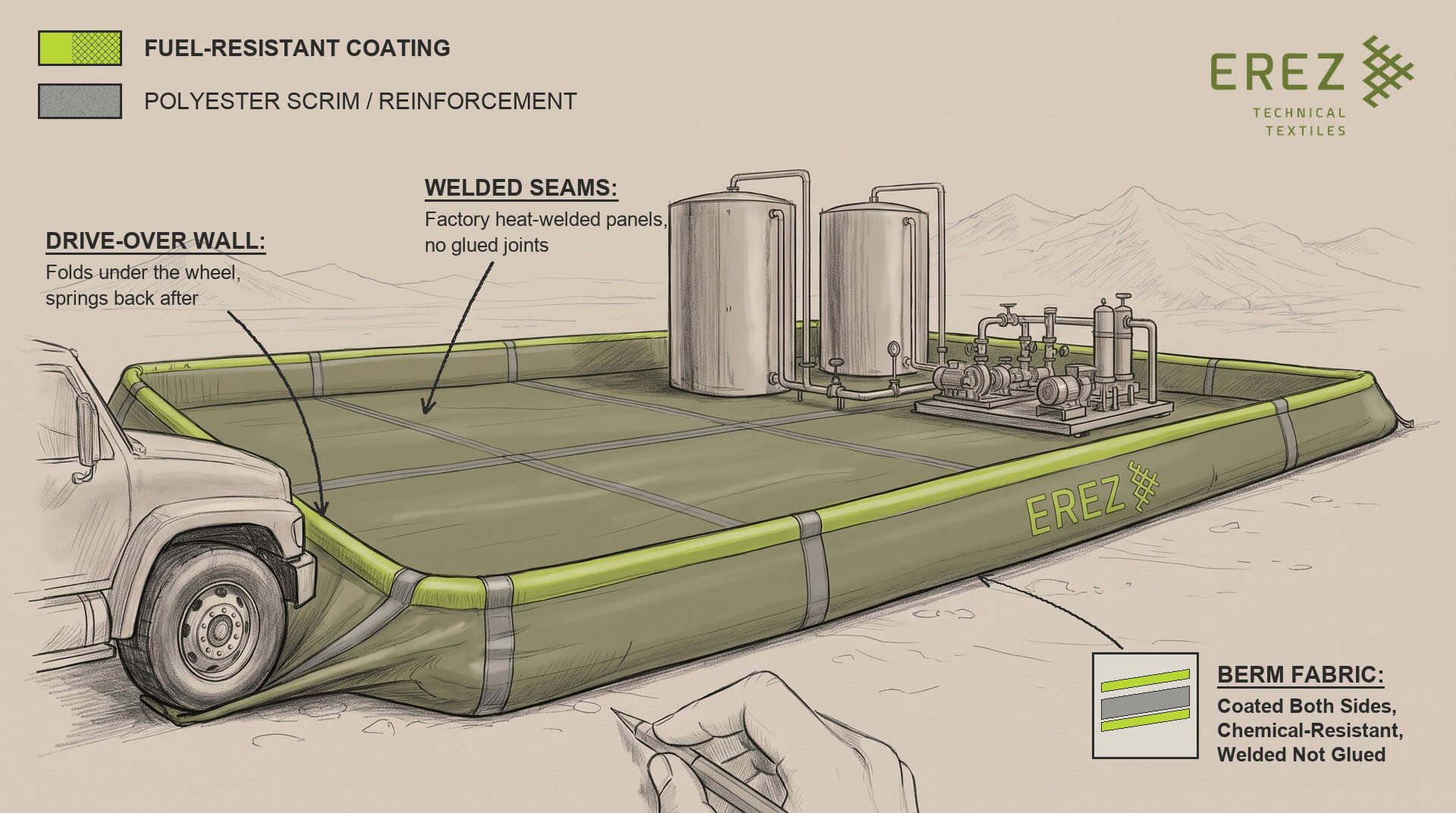
שתף פוסט זה

Secondary containment is a second barrier around a tank, drum or transfer point that holds a leak before it reaches soil, drains or groundwater. Most regulations do not prescribe one product. They set how much the containment must hold and require it to be impermeable to the stored liquid. This article summarizes the common requirements and explains how coated fabric berms and liners meet them.
What does secondary containment have to do?
- Hold the volume of the largest container, plus a margin for rainwater where it is outdoors.
- Stay impermeable to the stored liquid for as long as it may sit there.
- Withstand the site: sun, frost, vehicle traffic and handling.
What are the main secondary containment requirements?
Requirements differ by country and by liquid. Common reference points:
| Rule | Applies to | Capacity requirement |
|---|---|---|
| US EPA SPCC rule (40 CFR 112) | Facilities storing oil above set thresholds | Largest container plus sufficient freeboard for precipitation. 110% is the common industry practice. |
| US EPA hazardous waste containers (40 CFR 264.175) | Container storage areas for hazardous waste | 10% of the total volume or 100% of the largest container, whichever is greater |
| UK Oil Storage Regulations (England, 2001) | Oil stored above 200 liters at industrial and commercial sites | 110% of the largest container or 25% of the total, whichever is greater |
| Military berm liner specifications | Fuel storage in the field | Per MIL-B-53081 and ATPD 2262 |
Overview only. Always check the current rule with your local regulator.
How do you size a containment berm?
Start from the largest container the berm must hold, add the margin your rule requires, then choose dimensions that give that volume with the wall height available.
| Step | Example: one 4,000-liter fuel tank, outdoors |
|---|---|
| 1. Required volume | 110% of 4,000 L = 4,400 L, or 4.4 m³ |
| 2. Wall height | 0.3 m, low enough for a hose reel or a vehicle to reach the tank |
| 3. Floor area | 4.4 m³ ÷ 0.3 m ≈ 14.7 m², for example 4 m × 3.7 m |
| 4. Rain margin | Add wall height or area for the rainfall that may collect before the berm is emptied |
The tank’s own footprint also takes up volume inside the berm, so leave extra capacity when the tank stands inside it.
How often should secondary containment be inspected?
Regulations expect containment to be inspected regularly and kept empty of rainwater and spilled product, so that its full capacity is available when a leak happens. For fabric berms and liners, inspections look for punctures, worn areas where vehicles cross, damaged seams, and UV ageing on exposed walls. Weldable fabrics can be repaired with a welded patch.
Which types of secondary containment use coated fabric?
- Containment berms: portable basins with foam, collapsible or drive-over walls, placed under tanks, vehicles and drum stores.
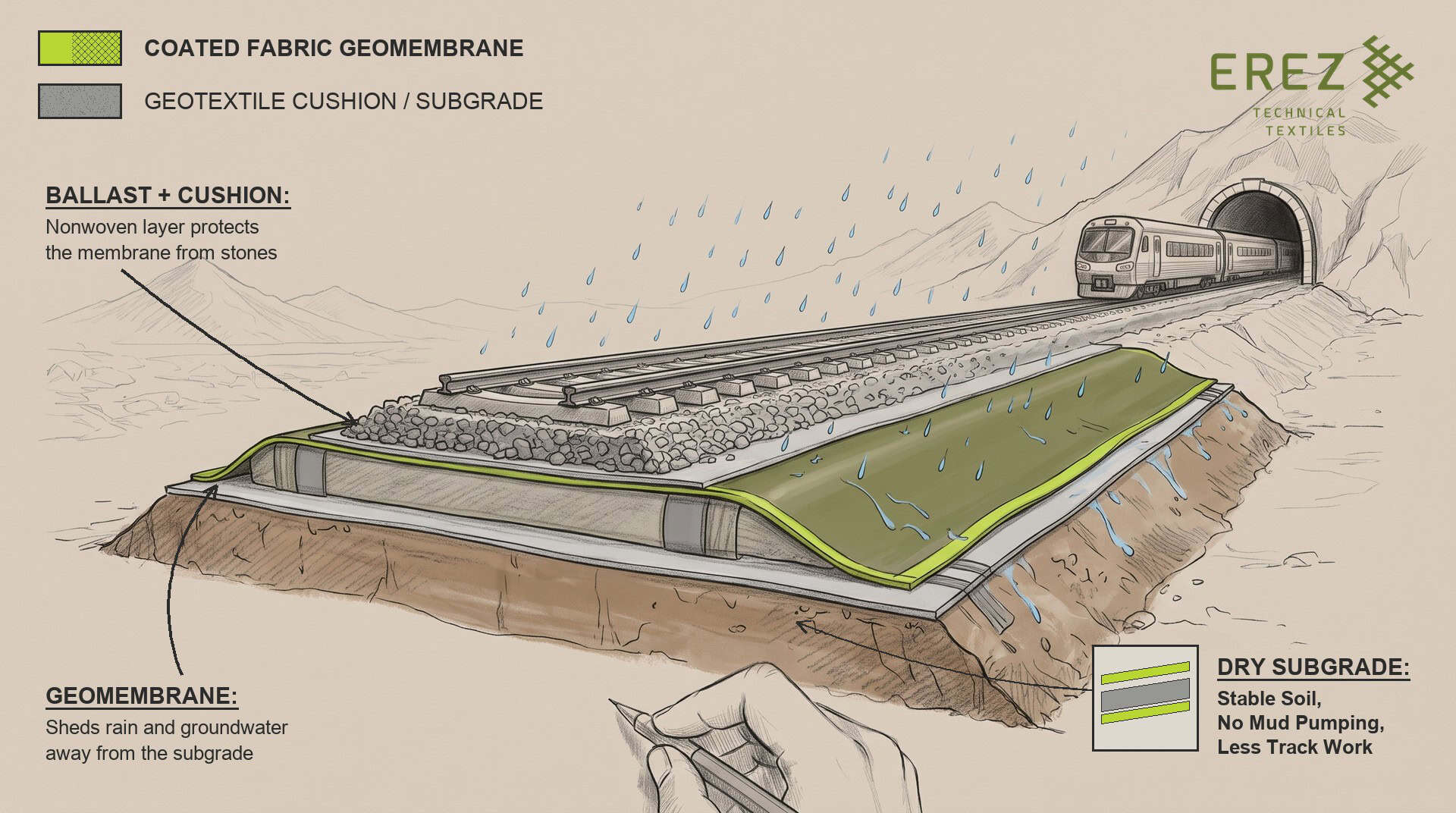
- Tank and bund liners: fabric liners inside concrete or earth bunds that make the bund impermeable.
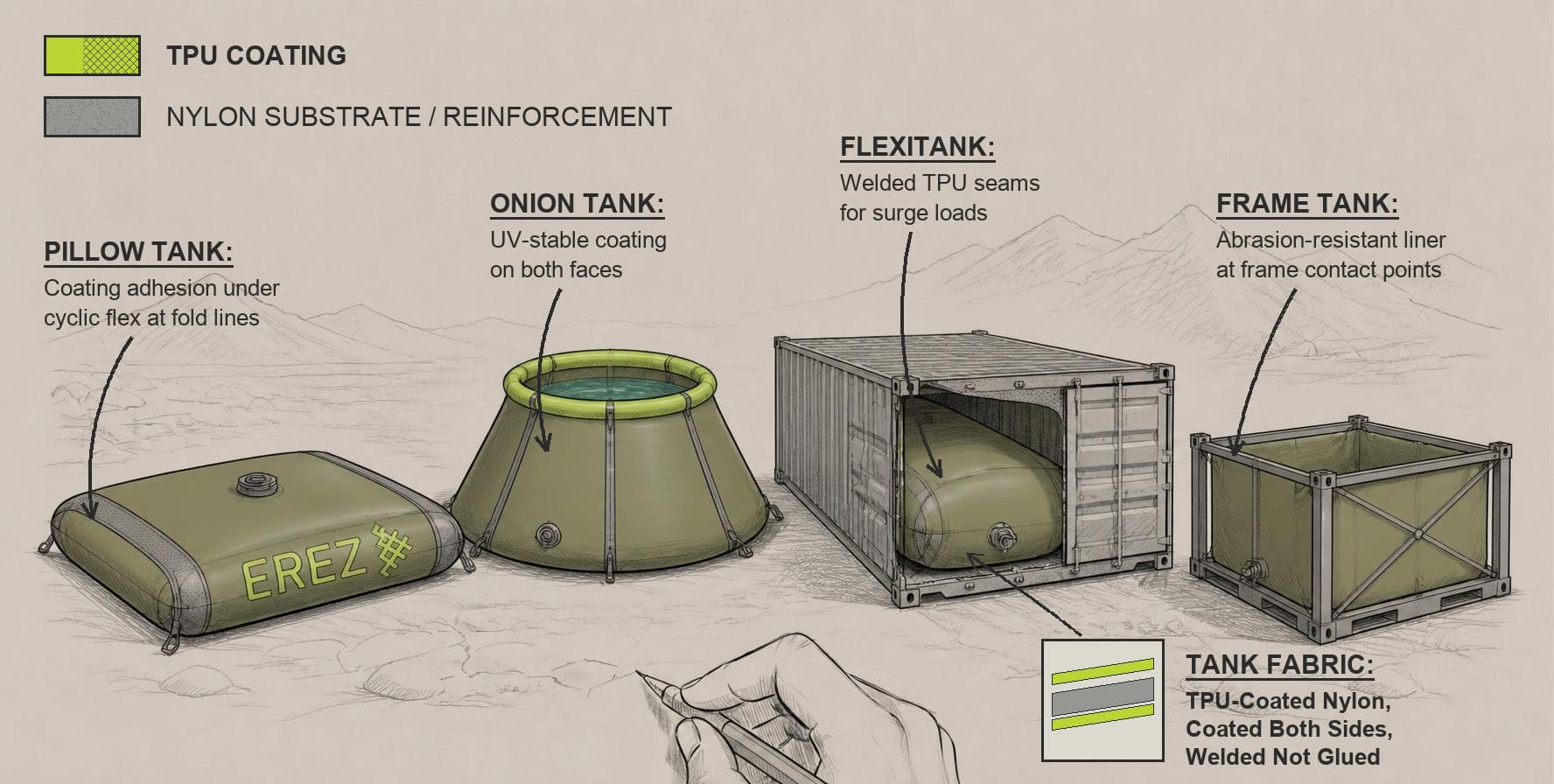
- Flexible tank containment: a second fabric layer or basin under a pillow tank or bladder.
What makes a good secondary containment liner?
A secondary containment liner must not react with the liquid it holds under any condition it will see on site. Beyond that, five properties decide its service life:
- Chemical compatibility with the specific fuel or chemical, including at high temperature.
- Puncture and abrasion resistance for gravel beds, tools and vehicle wheels.
- UV and weather resistance for outdoor sites.
- Cold-crack resistance where berms are folded and moved in winter.
- Welded seams that are as tight as the fabric itself.
Coated fabric or geomembrane?
Geomembranes are often used for large, permanent earth bunds. Reinforced coated fabrics are used where the containment must be portable, folded, welded into a berm shape, or driven over. The polyester scrim gives the tensile and tear strength that a vehicle-loaded or frequently moved berm needs.
Which Erez fabrics are used for secondary containment?
| Application | Erez grade | Why |
|---|---|---|
| Berms and bund liners for fuel and oil | ERcoat ER1000 | The most widely used grade for this application: hydrocarbon resistance, weldable |
See how New Naval used Erez fabric to build a drive-over fuel containment berm for a refinery loading bay.
FAQ
How much secondary containment is required?
Under the US SPCC rule, enough to hold the largest container plus rainwater. Under the UK Oil Storage Regulations, 110% of the largest container or 25% of the total. Other rules differ, so check the one that applies to your site.
What is a secondary containment liner?
An impermeable fabric or membrane that lines a bund or berm so that leaked liquid is held and cannot reach the ground.
Can a containment berm be driven over?
Yes, if it is designed for it, with walls that fold under the wheels and a floor fabric strong enough for the vehicle load.
Specifying a secondary containment product? Talk to an Erez textile expert about the right grade for your liquid and site.
Related reading: Spill containment solutions · Temporary liquid containment
שתף עם עמיתים
שתף פוסט זה
קרא עוד
השאירו תגובה
איך להבטיח את הטקסטיל הטכני הטוב ביותר עבור המוצר שלך?
בקש סקירה של מומחה עבור מפרט המוצר שלך
הזמן סקירת מומחה למוצר שלך