
Pillow Tank vs Onion Tank vs Flexitank: How Tank Type Determines Your Fabric Spec
Coating, Flexible Storage Tanks, International Standards, Welding, coated textile sourcingOct 11, 2026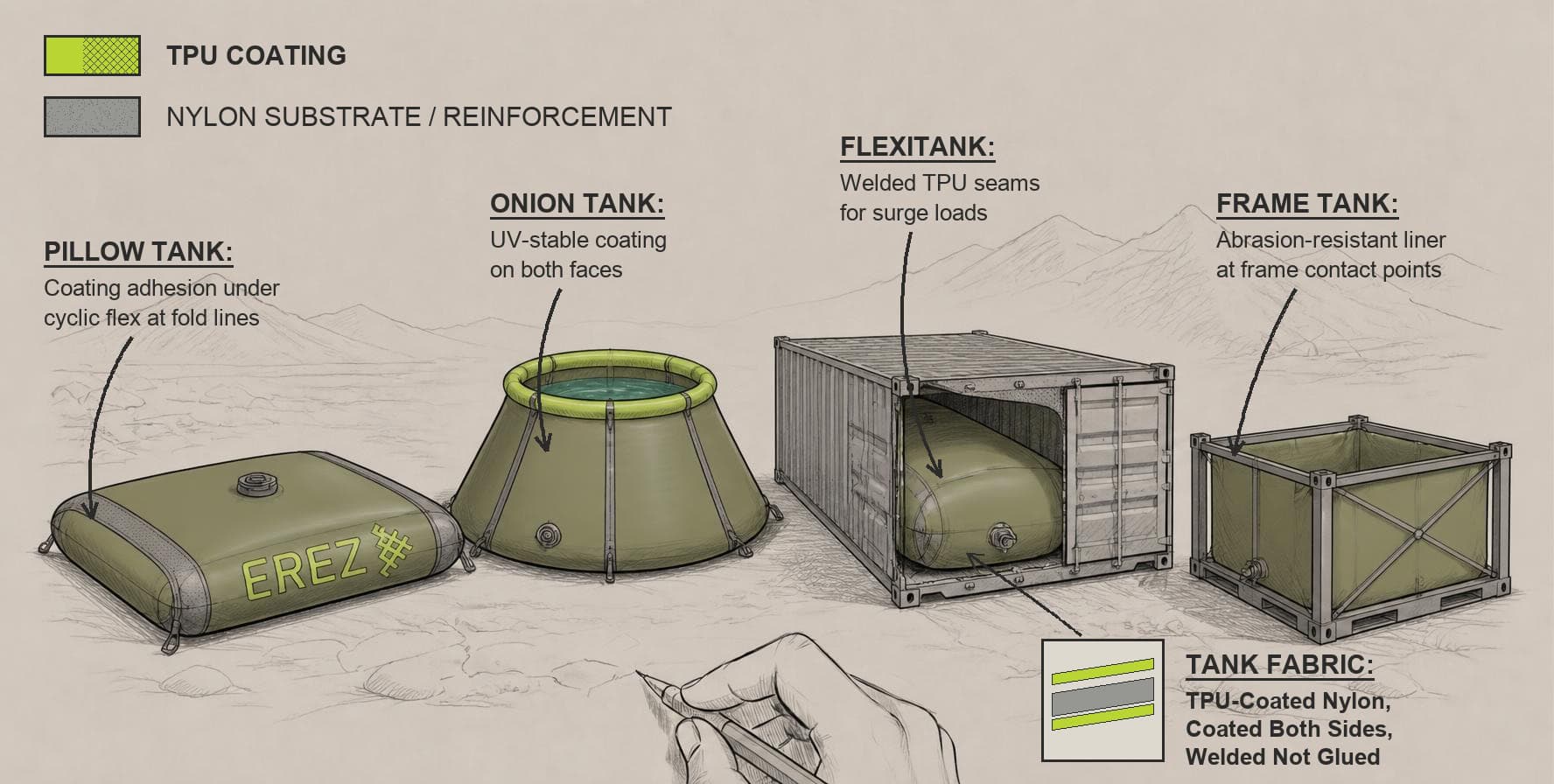
Condividi questo post

Most fabric specification for flexible storage tanks starts with the liquid. Potable water points to NSF/ANSI 61 or WRAS. Diesel points to a MIL-spec grade. Food products such as wine and edible oils point to FDA and EU food-contact compliance. That is the right first question, but it is not the only one.
Two tanks holding the same liquid in the same climate can fail in completely different places, because the tank format decides where the load goes. A pillow tank fails at the fold line. An onion tank fails at the sidewall under UV. A flexitank fails at the seam under longitudinal surge. Specifying the right chemistry and then ignoring the geometry is one of the more common ways a technically correct material ends up in a failed product.
This article breaks down the four main flexible tank formats and what each one demands from the coated textile.
Why Tank Geometry Decides the Spec
In a rigid tank, the wall carries the load and the liner only has to be chemically compatible. In a flexible tank, the fabric is the structure. Every hydrostatic force, every deployment cycle, and every point of mechanical contact passes through the coated textile.
That changes what matters. Tensile strength becomes a starting point rather than an answer. The properties that determine service life are the ones tied to how the specific tank format moves, folds, sits, and gets handled:
- Where the fabric creases, and how many times
- Which surfaces face the elements and UV, and for how long
- Exposure to harsh chemicals
- Whether load is static hydrostatic pressure or dynamic surge
- Where the fabric contacts sharp objects or anything harder than itself
- Whether the seam or the substrate is the weaker element under that particular load
Erez publishes a material selection guide for flexible liquid storage that works through liquid content, capacity, environment, and compliance. This article covers the layer above it: what the tank format itself adds to those requirements.
Pillow and Bladder Tanks: Fold Fatigue and Flange Stress
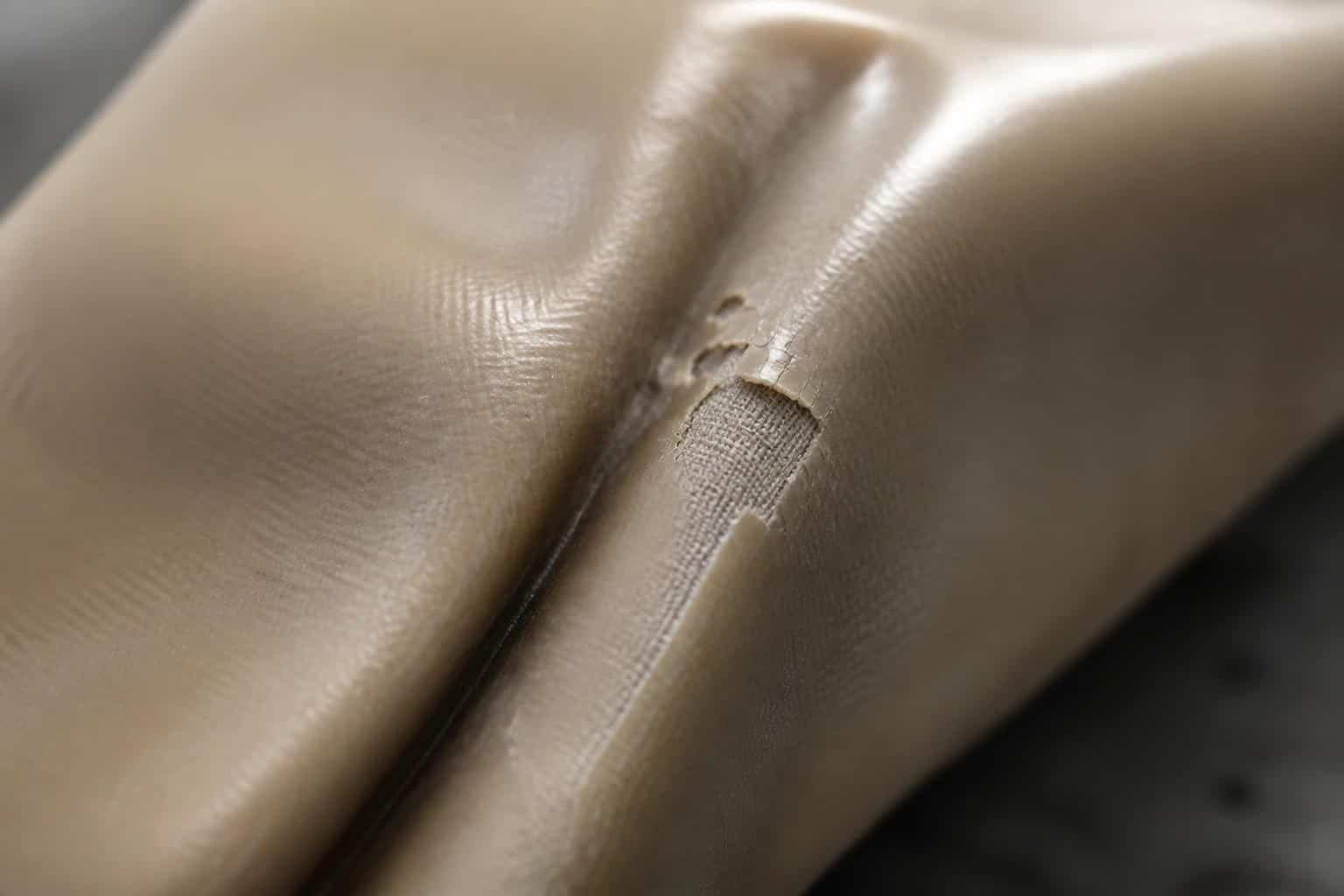
Pillow tanks are fully enclosed, entirely self-shaping, and carry no frame. The fabric does all the work. When empty, they fold flat for transport and storage, which is the whole point of the format and also the source of its dominant failure mode.
Fold fatigue. A tank that is deployed, drained, folded, moved, and redeployed creases in roughly the same places each cycle. Repeated flexing at a tight radius works the coating against the substrate. Over enough cycles this produces microcracking in the coating and, eventually, delamination from the base cloth. Once the coating separates, the barrier is gone even though the fabric still looks intact. Coating adhesion under cyclic flex matters more here than peak tensile figures.
Low-temperature flexibility. Folding a tank in cold conditions concentrates the problem. A coating that stiffens at low temperature will crack at the fold rather than bend. For tanks deployed across seasons or in cold climates, low-temperature flexibility is a hard requirement, not a nice-to-have.
Flange and fitting areas. Filling ports, discharge fittings, and air pressure relief valves concentrate stress at a small number of points, and those points see friction every time the tank is filled or emptied. These areas need reinforcement, and the reinforcement needs to bond properly. TPU-coated textiles can be welded rather than glued, which produces a reinforcement patch that is part of the structure instead of adhered to it.
Ground abrasion. The entire underside sits on whatever surface is available, often unprepared ground. Abrasion resistance on the outer face is a service-life factor.
Erez covers the agricultural and water side of this format in more depth in its article on bladder tanks.
Onion Tanks: What an Open Top Changes
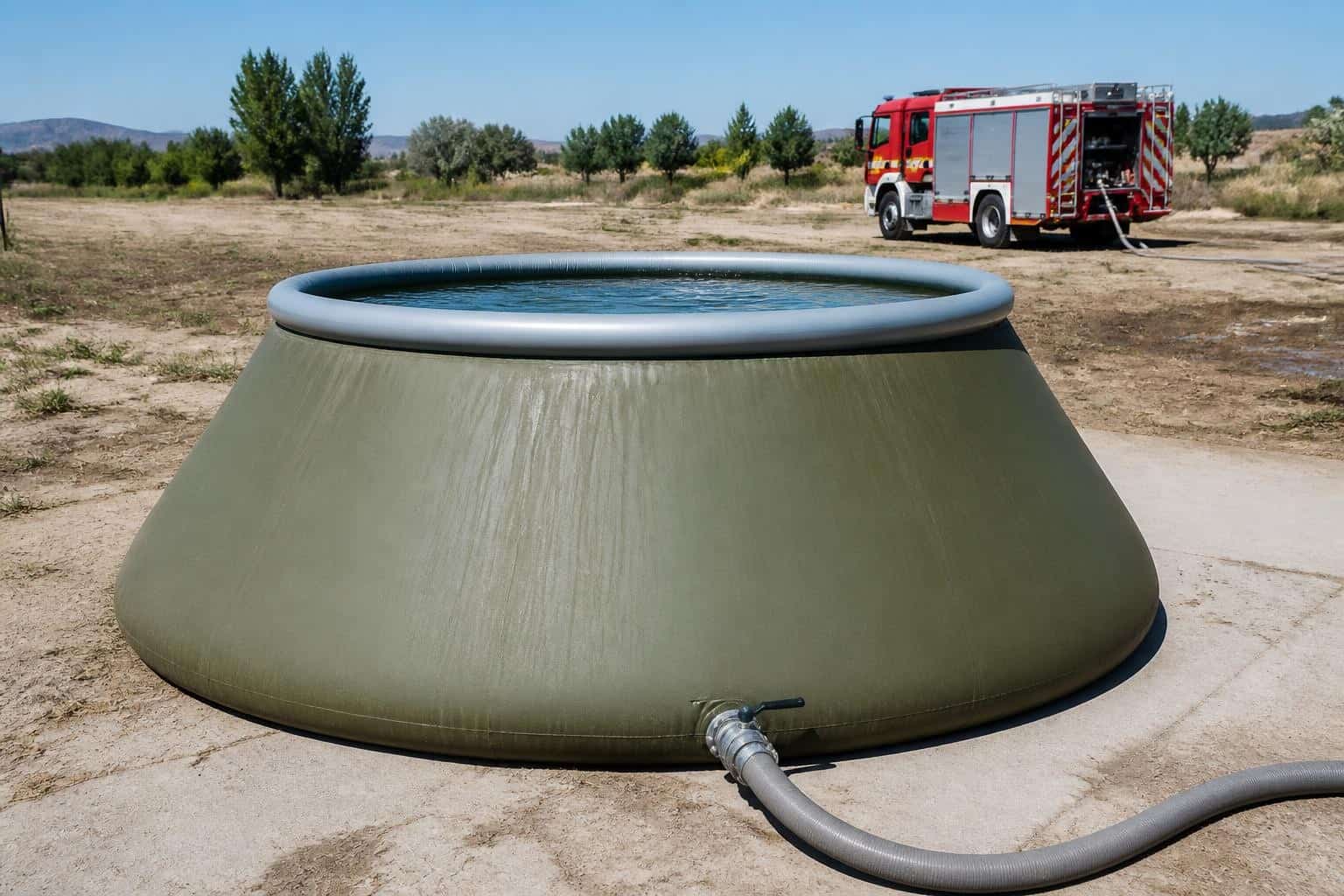
Onion tanks are open at the top, cone-shaped, and self-supporting. They deploy in minutes, fill fast, and drain by gravity. They are common in firefighting, emergency water supply, and spill response. The open top changes three things about the spec.
UV reaches both faces. In a pillow tank, only the outer surface is exposed. In an onion tank, sunlight reaches the inner sidewall and the liquid surface as well, so UV stability has to be specified for both faces of the fabric.
The sidewall has to hold itself up. As the tank fills, the wall rises and must stay standing without a frame. That requires a balance in fabric modulus. Too limp and the wall slumps inward as the level drops. Too stiff and the tank will not fold down to a practical transport size. This is a narrower specification window than pillow tanks require.
Contamination exposure. An open top admits airborne debris and contaminants. For potable water applications, that raises the stakes on certification rather than changing it. The relevant approvals are the same ones covered in NSF/ANSI 61 certification for flexible storage tank textiles.
Flexitanks: Fabric Requirements When the Tank Moves While Full
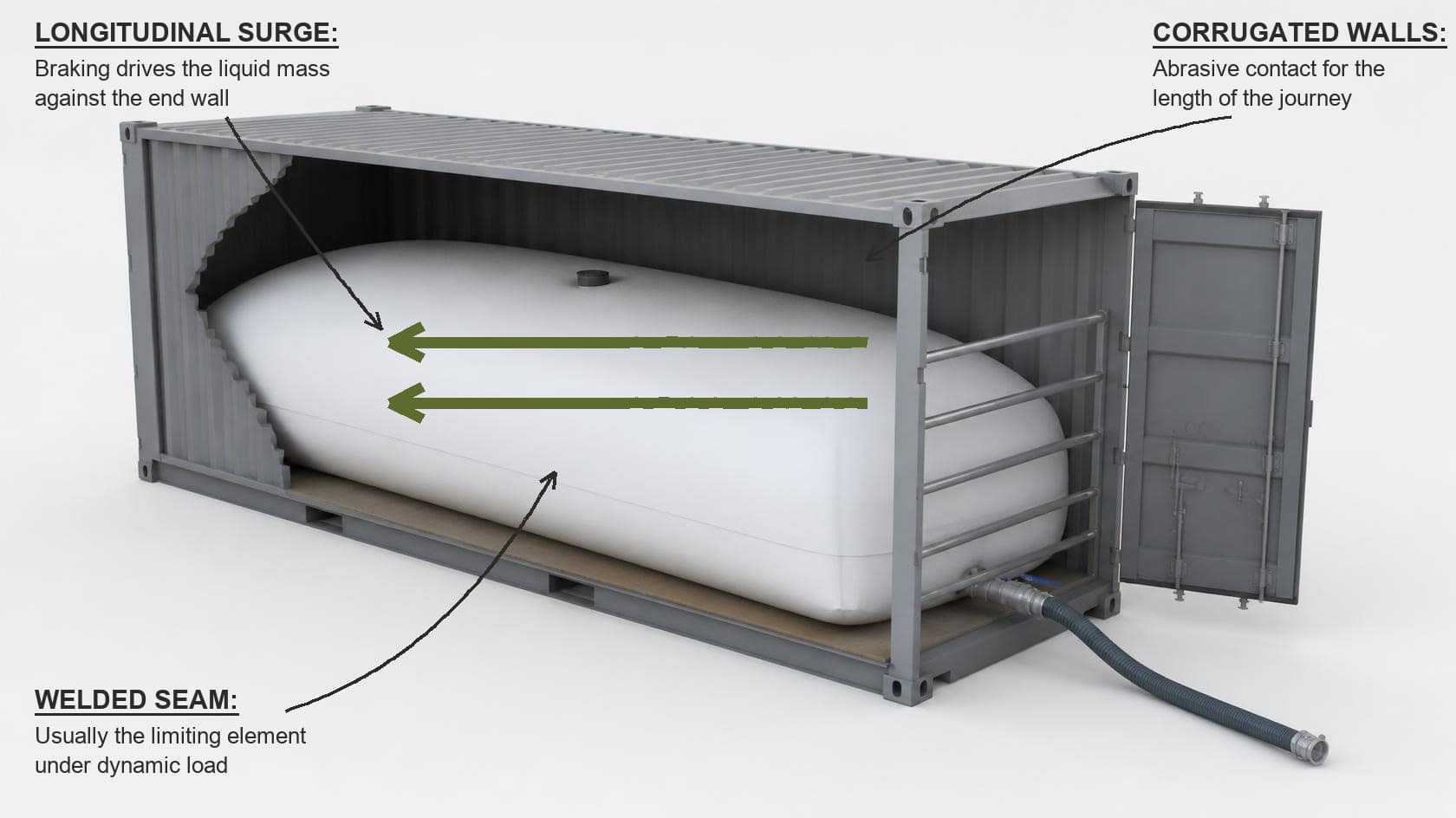
A flexitank is a bladder fitted inside a standard ISO container for bulk liquid transport. The defining difference is obvious once stated: this tank moves while it is full.
Dynamic load instead of static pressure. Braking, acceleration, and sea motion send the liquid mass surging against the end walls. Longitudinal surge during braking is the critical case. The load is not the steady hydrostatic pressure a stationary tank sees, it is repeated impact against a fixed boundary.
The seam is usually the limiting element. Under surge loading, well-specified fabric tends to outlast a poorly constructed seam. This is where welded construction separates from glued construction. Adhesive bonds have a finite shear capacity and degrade with cycling. Welded TPU seams fuse the coating layers into a continuous material, which is why weldability is a structural consideration for this format and not just a manufacturing convenience.
Abrasion against the container. Corrugated steel walls are an abrasive boundary, and the bladder works against them for the length of the journey.
Food contact compliance. A large share of flexitank volume is wine, juice, and edible oils, which brings FDA and equivalent food contact requirements into the specification alongside the mechanical ones. Erez covers the application range in its overview of flexitank storage uses.
Frame and Self-Supporting Tanks: When the Frame Carries the Load
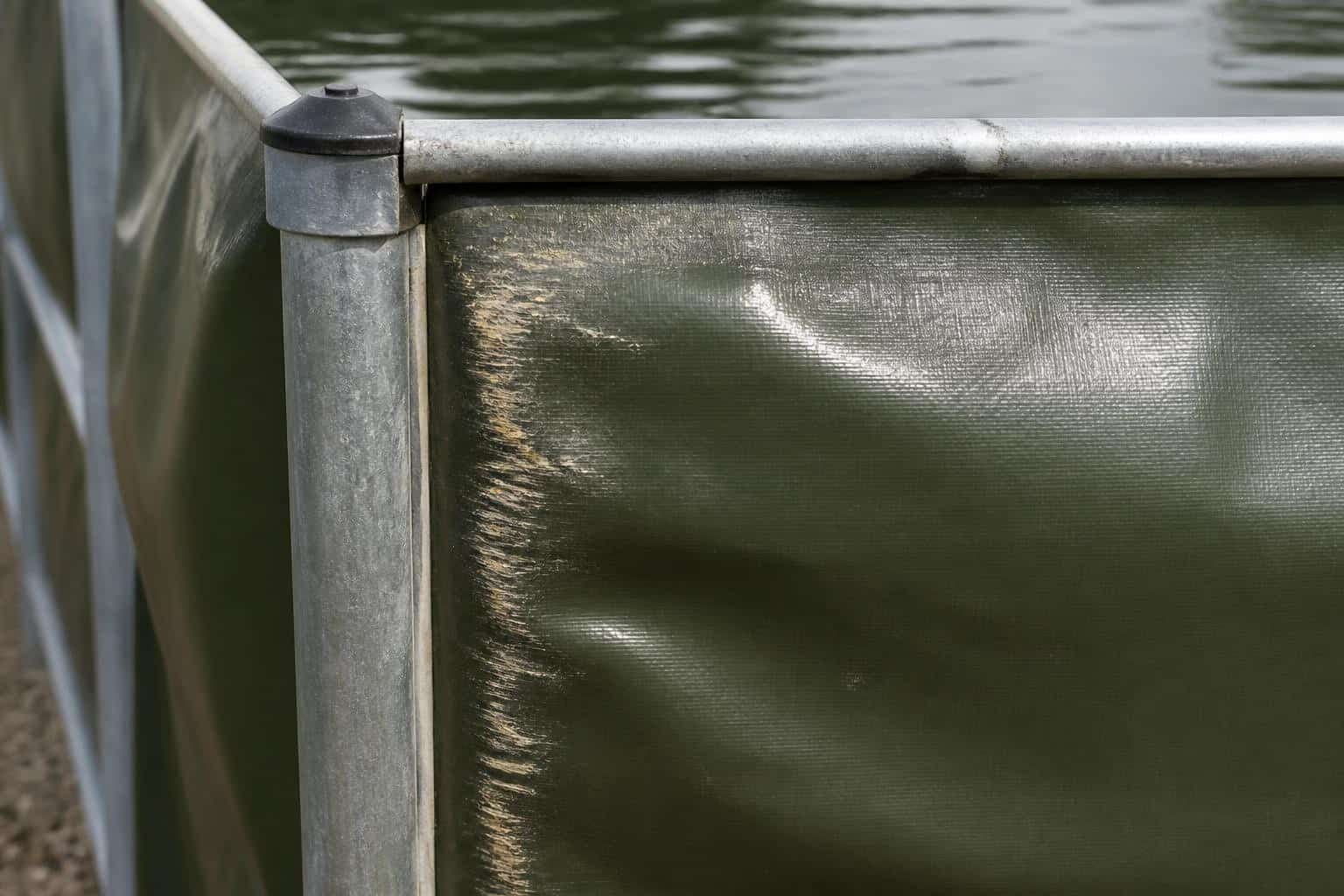
In a frame tank, an external steel or aluminium structure carries the hydrostatic load and the fabric functions as a liner. This inverts the priority order.
Tensile strength requirements drop, because the fabric is supported rather than load-bearing. What rises in importance is abrasion and puncture resistance at the points where the fabric meets the frame. Corners, rails, and joints are contact points under constant pressure from the liquid pushing the liner outward, and those are where liners wear through.
The second consideration is the collapse pattern. Frame tanks fold down along defined lines when struck, so the same fold fatigue logic that governs pillow tanks applies here, just at fewer and more predictable locations.
The practical consequence is that a frame tank liner can often run a lighter base cloth than a pillow tank of equivalent capacity, provided the contact points are properly specified.
Matching Tank Type to Liquid and Certification
| Liquid | Primary approvals | Format notes |
|---|---|---|
| Potable water | NSF/ANSI 61, WRAS, AS/NZS 4020:2005 | Onion tanks add contamination exposure; see WRAS-approved TPU for flexible storage tanks |
| Diesel and fuel | MIL-T-52983G, MIL-PRF-32233C | Vapor permeability and seam integrity are the controlling factors; see designing a flexible fuel storage tank |
| Food and beverage | FDA and equivalent food contact | Dominant in the flexitank format |
| Agricultural inputs and chemicals | Application-specific | Chemical compatibility must be confirmed against the specific formulation, not the category |
Erez supplies coated textiles across all four tank formats. Grade selection follows from the combination of format and liquid rather than either one alone. TPU 2180, for example, is a nylon base coated both sides and compliant with MIL-T-52983G and MIL-PRF-32233C, which suits collapsible fuel storage. A potable water onion tank in a high-UV deployment points toward a UV-stabilized grade with the relevant water approvals instead.
Frequently Asked Questions
What is the difference between a pillow tank and a bladder tank?
The terms are used interchangeably in most of the industry. Both describe an enclosed, frameless flexible tank that takes its shape from the liquid inside it.
Which flexible tank type lasts longest?
Service life depends more on how the tank is used than on the format. Enclosed formats such as pillow tanks and flexitanks protect the fabric from UV, which helps, but they accumulate fold fatigue from repeated deployment. Frame tank liners avoid most structural loading but wear at contact points.
Can the same fabric be used for a pillow tank and an onion tank?
Sometimes, but not by default. An onion tank needs greater UV stability on both faces and a narrower modulus range so the wall self-supports. A fabric specified for an enclosed pillow tank will not necessarily meet those requirements.
Why does weldability matter in tank fabric selection?
Welded seams fuse the coating layers into continuous material, while adhesive seams rely on a bond that degrades under cycling. In formats with dynamic loading, such as flexitanks, the seam is often the limiting element in the whole assembly.
Choosing between formats, or specifying fabric for one you have already chosen, comes down to matching mechanical behaviour and compliance to the same material. Schedule a technical review with the Erez textile team to work through the requirements for your application.
Related reading: Flexible Storage Tanks industry overview | Temporary liquid containment solutions by industry
TOPICS: Flexible Liquid Storage, TPU
Condividi con i colleghi
Condividi questo post
Per saperne di più

Lascia un commento
Come fate a garantire il miglior tessuto tecnico per il vostro prodotto?